Leave Your Message
China Top 10 Reduction Gearbox Manufacturers? This guide examines the companies behind China’s competitive transmission industry. A Reduction Gearbox may look compact, yet its performance depends on gear accuracy, bearing quality, lubrication, sealing, and heat treatment. Small faults can become loud vibration, oil leakage, or unexpected downtime.
Robert L. Norton, a respected mechanical engineer and machinery-design author, stated, “Gears are used to transmit motion and power between rotating shafts.” That simple principle explains the importance of selecting the right supplier. A reliable manufacturer must deliver more than a catalog ratio. It should provide measured torque data, rated service factors, noise information, material specifications, and practical installation support.
The manufacturers in this outline are assessed through technical capability, production experience, certification evidence, export history, customization capacity, and after-sales responsiveness. Attention also goes to planetary, helical, worm, bevel, and cycloidal designs. Each suits different loads, speeds, spaces, and efficiency targets.
Real factory conditions are less tidy. Some suppliers excel at standard units but struggle with unusual mounting requirements. Others offer impressive laboratories but limited field support. Marketing language can hide important gaps. That matters.
This article is not a laboratory ranking. It is a practical screening framework based on publicly available information and common engineering criteria. Product quality can vary between models, batches, and service conditions. Buyers should verify drawings, test reports, warranty terms, and references before placing an order.
The strongest Reduction Gearbox manufacturer is not always the largest. It is the supplier whose design, documentation, manufacturing discipline, and support match the application. That distinction deserves careful attention.
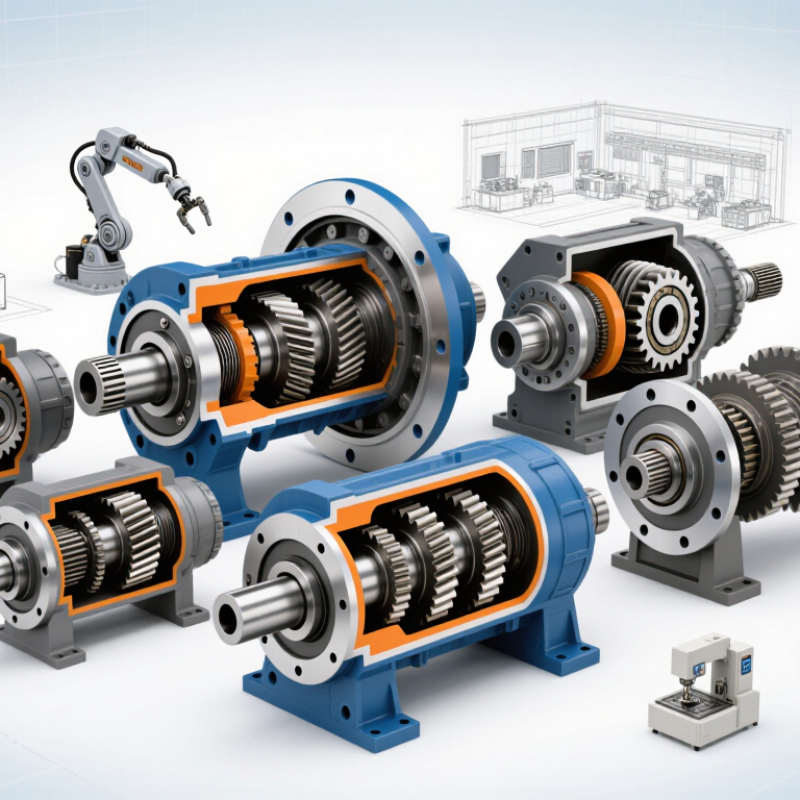
What Is a Reduction Gearbox and How Does It Work?
A reduction gearbox lowers shaft speed and increases usable torque. It connects a high-speed motor to a slower driven machine. Inside, meshing gears transfer motion through a selected ratio. For example, a 10:1 ratio can reduce 1,500 revolutions per minute to about 150. Torque rises, although friction removes part of the input power. The result is not free energy.
Helical, planetary, bevel, and worm arrangements suit different loads. Helical units usually offer strong efficiency and smooth operation. Worm gearboxes provide compact right-angle transmission, but their sliding contact can create more heat. Lubricant grade, alignment, bearing condition, and load cycles affect real performance. A theoretical ratio is not enough. Field inspections often find soft foundations, poor ventilation, or overloaded shafts. Small installation errors can shorten service life.
Market data shows why this component remains important. Grand View Research estimated the global industrial gearbox market at roughly USD 27 billion in 2023, with continued growth expected through the decade. MarketsandMarkets has also projected steady expansion in the broader gearboxes sector, driven by automation, material handling, renewable equipment, and process industries. These figures vary because researchers define “gearbox” differently. That limitation deserves attention. In practical selection, engineers should check output torque, service factor, efficiency, noise, thermal capacity, and maintenance access. A gearbox that fits the catalog may still fail in a dusty plant or under repeated shock loads. Proper sizing begins with measured operating data, not only motor horsepower.
Technical comparison of ten common reduction gearbox configurations used in industrial equipment
| No. | Gearbox Configuration | How It Works | Typical Reduction Ratio | Typical Efficiency | Torque and Speed Characteristics | Common Industrial Applications |
|---|---|---|---|---|---|---|
| 1 | Helical Gearbox | Angled teeth engage progressively, transferring motion smoothly between parallel shafts and increasing contact area. | 3:1 to 100:1 per stage; higher ratios are achieved with multiple stages. | Approximately 94%–98% per stage. | High continuous torque, low noise, and good thermal performance at moderate to high speeds. | Conveyors, mixers, compressors, pumps, material-handling systems, and general machinery. |
| 2 | Worm Gearbox | A worm screw meshes with a worm wheel, transferring motion through a compact right-angle drive. | 5:1 to 100:1 in a single stage; larger ratios are possible in multi-stage designs. | Approximately 50%–92%, depending on ratio, lubrication, and design. | High reduction in a compact housing; some designs provide limited back-driving resistance. | Hoists, gates, conveyors, packaging machinery, indexing equipment, and positioning systems. |
| 3 | Bevel-Helical Gearbox | A bevel gear stage changes the shaft direction, while helical stages provide efficient speed reduction. | 5:1 to 200:1, normally using multiple stages. | Approximately 93%–97% per stage arrangement. | High torque capacity with a 90-degree output direction and strong continuous-duty performance. | Inclined conveyors, bucket elevators, mixers, wastewater equipment, and process machinery. |
| 4 | Planetary Gearbox | Several planet gears rotate around a central sun gear inside an outer ring gear, sharing the transmitted load. | 3:1 to 100:1 per stage; multi-stage versions can exceed 1,000:1. | Approximately 95%–99% per stage. | Very high torque density, compact dimensions, low backlash options, and balanced load distribution. | Robotics, servo systems, machine tools, wind-turbine pitch systems, mobile equipment, and heavy automation. |
| 5 | Cycloidal Gearbox | An eccentric bearing drives a cycloidal disc whose lobes engage stationary pins, producing reduction through rolling contact. | 6:1 to 119:1 per stage; higher ratios use multiple stages. | Approximately 85%–95% per stage. | High shock-load resistance, high torque capacity, compact construction, and low backlash in precision designs. | Robotic joints, conveyors, agitators, lifting equipment, machine tools, and heavy-duty automation. |
| 6 | Spur Gearbox | Straight-cut gears mesh on parallel shafts to provide direct speed reduction. | 2:1 to 10:1 per stage; multiple stages provide higher ratios. | Approximately 95%–98% per stage. | Efficient and economical, but tooth engagement can create more noise and vibration at high speed. | Low-cost drives, small machinery, automation devices, electric actuators, and light-duty equipment. |
| 7 | Parallel-Shaft Helical Gearbox | Helical gear pairs operate on parallel shafts, usually in a narrow housing suitable for side-mounted installations. | 5:1 to 200:1 through multiple stages. | Approximately 94%–98% per stage. | High torque, efficient power transmission, and a compact profile for limited installation space. | Belt conveyors, chain conveyors, feeders, crushers, packaging lines, and process equipment. |
| 8 | Hypoid Gearbox | Offset spiral teeth transmit power between non-intersecting shafts, generally at a right angle. | 5:1 to 30:1 in common industrial configurations. | Approximately 90%–96%. | Quiet operation, high contact strength, and a lower output shaft position than many bevel designs. | Vehicle drives, compact conveyors, automated machinery, packaging systems, and right-angle power transmission. |
| 9 | Harmonic Strain-Wave Reducer | A flexible spline deforms inside a rigid circular spline, creating a large reduction with very few moving parts. | 30:1 to 320:1 in a single stage. | Approximately 70%–90%, depending on ratio and operating speed. | Very low backlash, high positioning accuracy, and compact size, but more sensitive to shock and overload. | Robotic joints, semiconductor equipment, optical devices, precision positioning, and aerospace mechanisms. |
| 10 | Right-Angle Spiral-Bevel Gearbox | Spiral bevel gears transfer power between intersecting shafts while reducing speed and increasing output torque. | 2:1 to 60:1, normally using one or more stages. | Approximately 92%–97% per stage. | Smooth right-angle transmission, high load capacity, and good efficiency for continuous operation. | Robotic equipment, conveyors, printing machinery, machine tools, food-processing systems, and packaging lines. |
Technical note: A reduction gearbox decreases input speed and increases output torque through gear-ratio multiplication. Actual ratio, efficiency, allowable torque, service life, noise level, and thermal capacity vary with the design, lubrication, load profile, operating speed, mounting position, and manufacturing standards. The figures above are typical engineering ranges rather than a ranking of individual manufacturers or brands.