Top Motor Reducer Manufacturers Worldwide?
Choosing among the top Motor Reducer manufacturers worldwide requires more than comparing catalog prices. A reducer may look compact on a specification sheet, yet its real performance appears under load, heat, vibration, and continuous operation. Factory engineers often inspect gear tooth finishing, bearing arrangement, sealing quality, lubrication access, and motor compatibility. These details influence service life inside conveyors, packaging lines, robotic cells, pumps, and automated warehouses.
Darle W. Dudley, a respected gear-design authority, offered a practical principle: “Good gear design begins with understanding the load.” That idea remains highly relevant to Motor Reducer selection. A manufacturer with advanced machining equipment may still be unsuitable for a dusty plant or a washdown environment. Application experience matters. So does after-sales support.
This guide examines leading global manufacturers through measurable criteria, including product range, torque capacity, efficiency, noise control, customization, testing procedures, certifications, delivery capability, and technical service. It also considers real operating concerns, such as backlash after prolonged cycling or lubricant leakage near sensitive equipment. These issues are easy to overlook.
No ranking is permanently perfect. Market leadership changes with technology, regional support, and customer needs. A company strong in precision robotics may not offer the best solution for heavy material handling. Buyers should verify test data, warranty terms, spare-parts availability, and local engineering support before deciding. Even experienced teams can misjudge a reducer when they rely only on brand familiarity.
Motor Reducers Explained: Gear Ratios, Torque, and IEC 60034-30-1
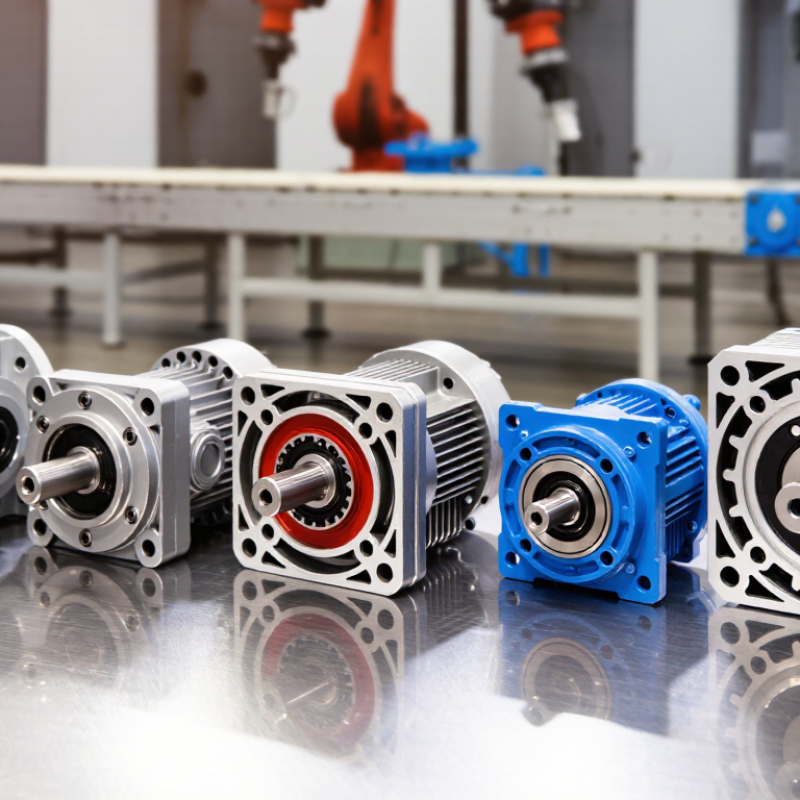
A motor reducer combines an electric motor with gears to trade speed for usable torque. Gear ratio controls this change. A 20:1 reducer connected to a 1,500 rpm motor produces approximately 75 rpm at the output shaft. The calculation is simple, but real performance is not.
Output torque depends on motor torque, ratio, and mechanical efficiency. A 10 Nm motor with a 20:1 ratio may deliver about 170 to 180 Nm after gearbox losses. Friction, lubrication, bearing condition, and operating temperature affect that result. Starting torque also matters. A conveyor may run at 75 rpm, yet require far more torque during acceleration. Select a service factor for shocks and repeated starts.
IEC 60034-30-1 classifies the energy efficiency of certain line-operated AC motors, using IE efficiency classes. It does not rate the complete reducer assembly. The motor, gearbox, inverter, and driven machine should be assessed together. A higher-efficiency motor can still waste energy if the reducer is poorly matched or oversized. Check rated speed, thermal limits, noise, duty cycle, shaft loads, and documentation from qualified manufacturers. In practical comparisons, consistent test conditions matter more than impressive catalogue numbers. A spreadsheet can look convincing. Field conditions often disagree.
Ranking Criteria: ISO 9001, IP Ratings, IE3/IE4 Efficiency, and Torque
Top Motor Reducer Manufacturers Worldwide?
A reliable ranking begins with verifiable manufacturing evidence, not impressive advertising. ISO 9001 certification shows controlled processes, documented inspections, and corrective actions. It does not guarantee every gearbox will perform perfectly. Audit dates and certificate scopes require careful checking. Numbers need context. Experienced buyers should review test reports, material records, and failure data from comparable applications. Torque tells the story. A reducer must deliver rated torque continuously, while handling starting loads, shock, and duty cycles. Published torque should match the actual operating speed and service factor. Otherwise, a compact unit may fail under repeated production demands.
IP ratings indicate protection against dust and water, but they are not universal durability scores. An IP65 enclosure may resist water jets, yet installation quality still matters. IE3 and IE4 efficiency ratings help compare motor energy performance under defined test conditions. They do not measure the complete reducer system. Coupling losses, lubrication, alignment, and load variation can change field results. A practical ranking should therefore combine laboratory figures with application evidence. Inspectors can check noise, temperature rise, backlash, and vibration during commissioning. Small details matter. I would also question unusually high torque claims without independent validation. The best comparison remains imperfect, because factories, climates, maintenance habits, and operating loads differ widely.
Top Motor Reducer Manufacturers Worldwide? - Ranking Criteria: ISO 9001, IP Ratings, IE3/IE4 Efficiency, and Torque
| Rank |
Anonymous Manufacturer Profile |
ISO 9001
Quality System |
Typical IP
Protection |
IE3 Efficiency
Availability |
IE4 Efficiency
Availability |
Typical Output
Torque Range |
Indicative
Score |
| 1 |
Global Heavy-Duty Integrated Drive Profile |
Certified |
IP55–IP66 |
Standard |
Selected models |
10,000–100,000+ Nm |
94/100 |
| 2 |
Industrial Helical and Bevel Drive Profile |
Certified |
IP55–IP65 |
Standard |
Common options |
500–20,000 Nm |
91/100 |
| 3 |
Modular Parallel-Shaft Drive Profile |
Certified |
IP55–IP66 |
Standard |
Selected models |
1,000–30,000 Nm |
89/100 |
| 4 |
High-Efficiency Inline Gearmotor Profile |
Certified |
IP54–IP66 |
Standard |
Available |
50–5,000 Nm |
87/100 |
| 5 |
Compact Worm Gearmotor Profile |
Certified |
IP54–IP65 |
Selected models |
Limited |
5–2,000 Nm |
81/100 |
| 6 |
Precision Planetary Reducer Profile |
Certified |
IP54–IP65 |
Motor-dependent |
Motor-dependent |
100–50,000 Nm |
79/100 |
Evaluation basis: ISO 9001 refers to a certified quality-management system; IP ratings follow IEC 60529; motor efficiency classes IE3 and IE4 follow IEC 60034-30-1. Torque values are typical output-torque bands for the stated product profiles and depend on gear ratio, speed, duty cycle, service factor, and thermal limits. The indicative score uses a brand-neutral weighting of ISO 9001 certification, IP protection, IE3/IE4 availability, torque capability, and industrial application suitability.
Leading Motor Reducer Manufacturers by Region, Technology, and Product Range
Motor reducer manufacturers vary widely by region, technology, and product range. European suppliers often emphasize precision machining, low backlash, and long service intervals. Their gearboxes commonly serve robotics, packaging lines, and medical equipment. East Asian manufacturers frequently offer broad catalogs and competitive production for conveyors, mixers, and factory automation. North American producers often focus on customized drive systems, service support, and harsh industrial environments.
Technology strongly influences selection. Helical reducers provide efficient, quiet power transmission for continuous-duty machines. Worm reducers suit compact layouts and high reduction ratios, although heat loss can become significant. Planetary designs deliver high torque in a small housing, while cycloidal units handle shock loads effectively. Servo-compatible reducers require careful attention to backlash, torsional stiffness, and mounting accuracy. A larger motor is not always better.
Product range also reveals manufacturing capability. Reliable suppliers usually provide multiple frame sizes, input options, shaft arrangements, seals, and mounting positions. They should publish torque curves, thermal ratings, material specifications, and test procedures. In practical purchasing work, these documents matter more than polished advertisements. Check the duty cycle.
Regional comparisons can mislead. A manufacturer with excellent standard products may struggle with unusual loads or local service requirements. I have seen technically suitable reducers fail because lubrication, alignment, or cooling was overlooked. That uncomfortable detail deserves attention. Buyers should verify application data, replacement lead times, warranty terms, and field support before approving a final design.
Top Brands for 1–100 kW Drives, Robotics, Conveyors, and Automation
Top Motor Reducer Manufacturers Worldwide?
For 1–100 kW drives, leading motor reducer manufacturers are judged by more than production volume. Engineers compare torque density, thermal capacity, backlash, sealing, service life, and replacement support. Helical, planetary, worm, and cycloidal designs each suit different duties. Conveyor lines often need steady torque and simple maintenance. Robotic axes demand low backlash and repeatable positioning.
The International Federation of Robotics reported 541,302 industrial robots were installed worldwide in 2023. That figure shows why compact, precise reducers remain important in automation. The U.S. Department of Energy also reports that motor-driven equipment uses a large share of industrial electricity. Efficient gearing can reduce losses, but only when sizing matches the load. A reducer running far below its rated capacity may waste money and space. A unit operating near its limit may overheat quickly. The choice is not always obvious.
Tips:
Check the actual duty cycle, not only motor power. Record starts per hour, shock loads, ambient temperature, mounting direction, and required output speed. For a 7.5 kW conveyor, for example, calculate starting torque before selecting a ratio. For robotic applications, request measured backlash and repeatability data. Test noise at the real operating speed. Small details matter. Industry reports provide useful market context, but field measurements should guide the final decision. Some published ratings also assume ideal conditions, which deserve skepticism.