Top Benefits and Applications of Step Motors in Modern Technology?
In the rapidly evolving landscape of modern technology, step motors play a crucial role. These devices convert electrical pulses into precise mechanical movements. Industries are increasingly relying on step motors for their unmatched accuracy and reliability. According to a recent report by MarketsandMarkets, the step motor market is projected to reach $4.9 billion by 2025, indicating a compound annual growth rate (CAGR) of 6.4%.
Step motors are widely used in applications ranging from robotics to 3D printing. Their ability to provide precise positioning makes them essential in automation systems. Researchers highlight that step motors can achieve angular accuracy as high as 1.8 degrees per step. Such precision is vital in fields like medical equipment and CNC machines. Yet, some challenges remain, including vibration issues and torque loss at higher speeds.
Innovation in driver technology continues to address these problems. Developers aim to enhance step motor performance while minimizing limitations. Understanding these benefits and challenges is essential for industries looking to adopt step motors. Embracing advancements can lead to improved efficiency and productivity in various applications.
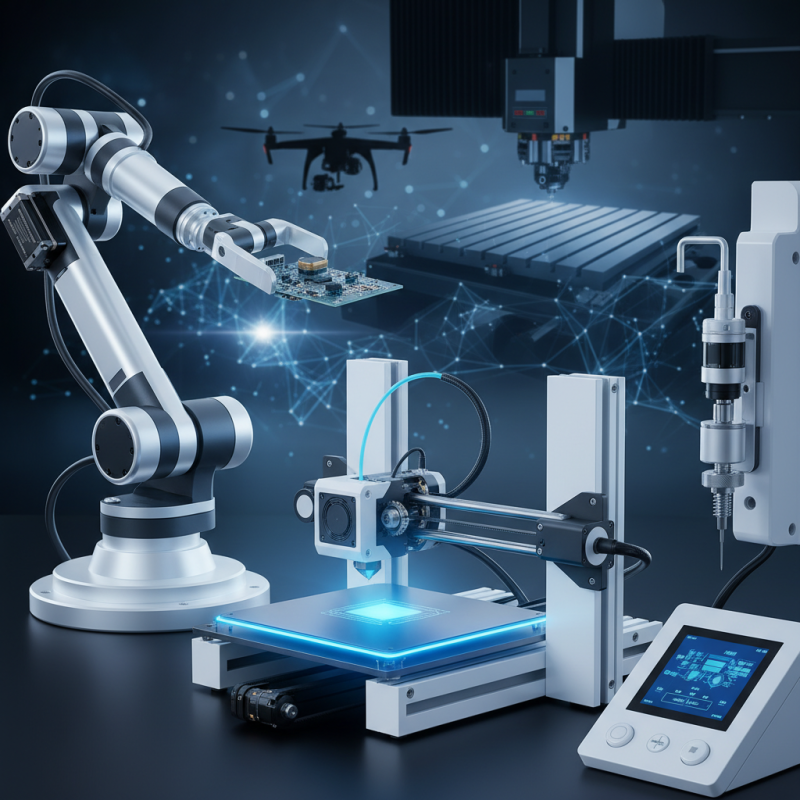
Key Characteristics of Step Motors in Modern Technology
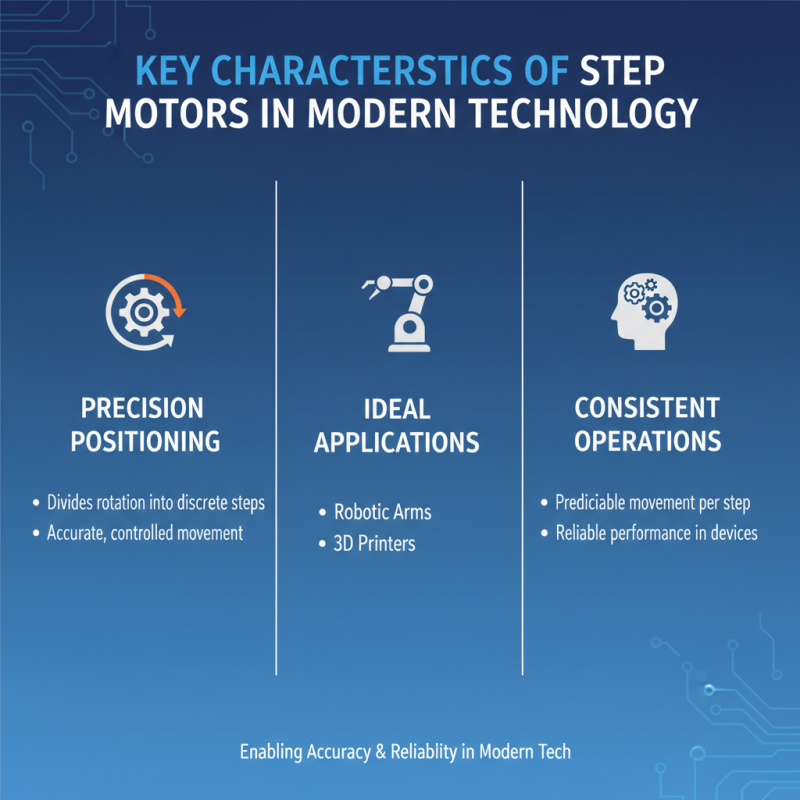
Step motors, also known as stepper motors, are crucial in modern technology, especially in precision applications. Their ability to divide a full rotation into a series of discrete steps allows for precise positioning. This makes them ideal for robotic arms and 3D printers, where accuracy is crucial. With each step, the motor moves predictably, enabling consistent operations across various devices.
One of the key characteristics of step motors is their holding torque. They maintain position without the need for additional power, which is beneficial in applications like CNC machines. However, improper control can lead to missed steps or loss of positioning, causing frustration and requiring recalibration. Additionally, their response time can be slower than traditional motors in high-speed applications, highlighting a potential drawback.
Another important feature is their wide range of motion capabilities. Step motors can operate at both low and high speeds, but this versatility can also lead to inefficiencies in energy consumption. Over time, manufacturers must consider the balance between power usage and performance integrity. Understanding these key characteristics can help engineers choose the right motor for their projects, ensuring optimal efficiency in modern technology applications.
Advantages of Step Motors over Traditional Motors
Step motors have gained significant traction in modern technology due to their unique advantages. One key benefit is their precise control over positioning and speed. In industries like robotics and 3D printing, accuracy is paramount. Data from industry reports show that step motors can achieve step angles as small as 0.9 degrees, allowing for finer movements compared to traditional motors. This level of precision makes them indispensable in applications requiring exact positioning.
Another major advantage is the simplicity of control. Unlike traditional motors, which require complex feedback systems, step motors operate in an open-loop configuration. This reduces system complexity and enhances reliability. Research indicates that step motors can increase efficiency by up to 30% in certain applications. However, they can also generate more heat and may struggle with rapid acceleration, which are challenges that need careful consideration.
In automation and manufacturing, the ease of integration is vital. Step motors are compatible with various control systems, making them versatile. Their ability to maintain torque at low speeds is another benefit. However, one should be mindful of the potential for resonance issues in specific scenarios. Continuous technical advancements aim to address these limitations, further enhancing the applicability of step motors across diverse sectors.
Common Applications of Step Motors in Robotics and Automation
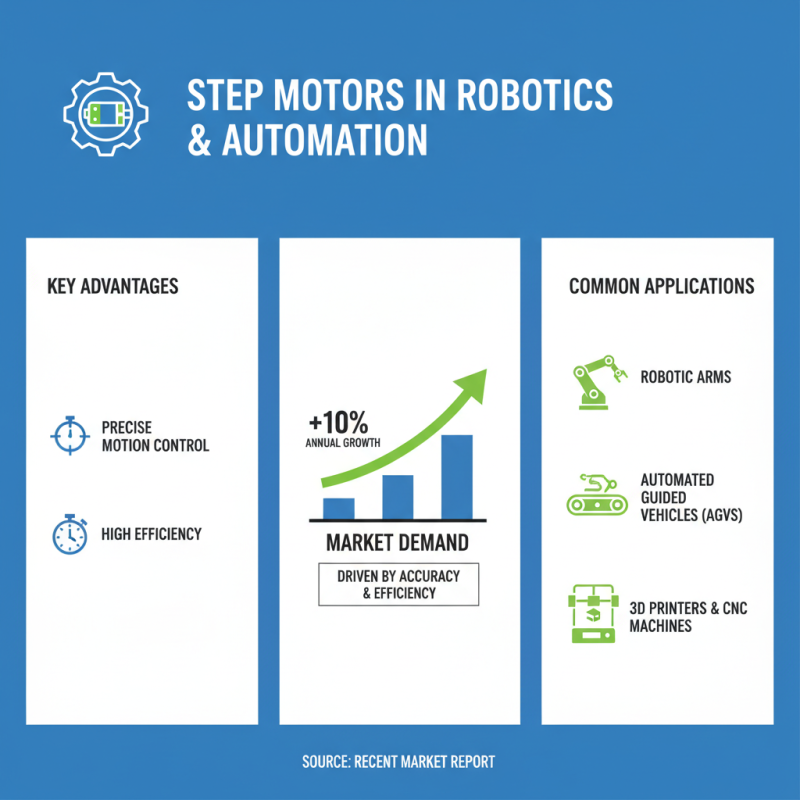
Step motors are increasingly pivotal in robotics and automation. They provide precise control over movement, making them ideal for various applications. According to a recent market report, the demand for step motors in automation is expected to grow by 10% annually. This growth is driven by the need for accuracy and efficiency in automated tasks.
In robotics, step motors are essential for controlling joints and limbs. They enable smooth, repeatable movements, which is critical in robotic arms used in manufacturing. These motors can hold their position without consuming power, a feature that enhances energy efficiency. For instance, a robotic arm equipped with step motors can perform delicate surgical procedures with remarkable precision.
Despite their advantages, there are challenges. One challenge is the inherent resonance that can affect performance. Moreover, step motors require careful implementation to avoid missed steps during operation. This detail underscores the need for expertise in integrating these motors into complex systems. With ongoing advancements, the applications of step motors will likely expand, possibly bringing more innovations to the field.
Integration of Step Motors in Precision Control Systems
In modern technology, step motors play a vital role in precision control systems across various industries. These motors deliver high accuracy and repeatability, essential for applications such as robotics, CNC machinery, and 3D printing. According to a report by Market Research Future, the global stepper motor market is expected to grow by over 7% annually, indicating a robust demand for precision control solutions.
One key advantage of step motors is their ability to maintain fixed positions without needing continuous power. This feature is particularly useful in applications requiring stability, such as medical devices and automated assembly lines. However, it’s worth noting that step motors can lose position under high load conditions, which may lead to system inaccuracies.
Tips: Regular maintenance can significantly enhance performance. Always monitor load conditions to ensure optimal efficiency. Understanding the specific torque and speed requirements of your application is crucial. Additionally, consider integrating closed-loop systems to mitigate the risks of losing steps in high-demand scenarios. Employing these strategies can lead to improved reliability in your projects.
Top Benefits and Applications of Step Motors in Modern Technology
| Benefit/Application |
Description |
Industry |
Precision Level |
| High Precision Control |
Step motors provide accurate positioning and repeatability, essential for applications requiring tight tolerances. |
Manufacturing |
High |
| Open Loop Control |
Step motors can operate without feedback systems, reducing complexity and cost in system design. |
Robotics |
Medium |
| Low Cost |
The relatively low price of step motors makes them accessible for various applications, including hobby projects and prototyping. |
Consumer Electronics |
Low |
| Simplicity of Control |
Step motors can be controlled easily with simple control signals, making them user-friendly for developers. |
Medical Devices |
Medium |
| High Holding Torque |
Step motors provide good holding torque while stationary, beneficial for applications requiring maintaining a position under load. |
Automation |
High |
Future Trends and Innovations in Step Motor Technology
The future of step motor technology is vibrant and full of promise. Innovations are emerging that enhance precision and efficiency. Research is focusing on integrating artificial intelligence and machine learning into step motor systems. This can lead to smarter automation processes. As industries demand more from their machinery, adaptability becomes crucial. Step motors are evolving to meet these needs.
New materials and manufacturing techniques are revolutionizing step motor design. Lighter, more durable components are now possible, leading to increased performance. The push for energy efficiency is also driving changes. More efficient motors consume less power and generate less heat. This development is vital for applications in robotics and electric vehicles.
However, challenges remain for step motors. Balancing performance with cost-effectiveness requires careful consideration. Higher precision often leads to increased complexity in control systems. Designers must navigate these trade-offs. The conversation about sustainability in manufacturing is ongoing. Future innovations will need to address environmental concerns while improving functionality. As technology progresses, step motors hold the potential to shape various fields significantly.