How to Choose a Planetary Gearbox in 2026
Choosing a planetary gearbox in 2026 starts with the job it must perform, not just its advertised torque. Planetary Gearboxes combine compact dimensions with high torque capacity, making them useful in robotics, packaging equipment, mobile machinery, and other space-constrained systems. But a small housing does not guarantee a suitable fit. Operating conditions matter.
Start with the driven load. Record its required speed, continuous torque, peak torque, duty cycle, and expected service life. Then check the gearbox ratio, input speed, mounting arrangement, backlash, and shaft limits. A conveyor that runs steadily presents different demands from a robotic arm that accelerates and stops repeatedly. Heat, shock loads, and frequent reversals can also affect performance. Small details count.
A datasheet is a useful starting point, not a complete design review. Confirm how the manufacturer defines torque ratings and service factors, and ask whether ratings apply to your actual operating conditions. Check lubrication, temperature range, sealing, noise, and maintenance access before settling on a model. For a precise selection, share the motor and load data with the gearbox supplier or a qualified engineer. It is not magic. Real systems rarely match every assumption on paper, and that gap deserves attention. A gearbox that looks ideal by ratio alone may still be poorly matched to the machine. This guide outlines the key checks, trade-offs, and questions that help narrow the options without treating a catalog number as the whole answer.
Identify the Application and Operating Requirements
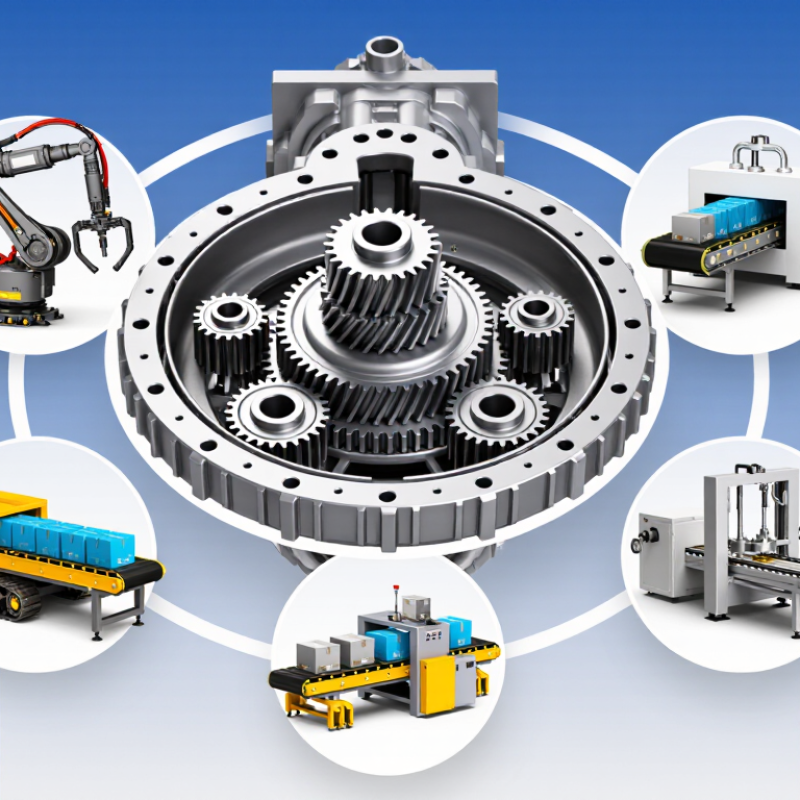
Choosing a planetary gearbox starts with the application, not the catalogue. Describe the machine’s motion, load, speed, and available space. A rotary table may need precise intermittent positioning, while a conveyor usually demands steady torque. These systems should not share the same initial calculation.
Measure continuous torque and peak torque separately. Record acceleration time, stopping frequency, and duty cycle. A motor producing 10 Nm may create much higher torque during rapid starts. That short spike can damage teeth, shafts, or bearings. I have seen early estimates fail because operators reported average loads only. Peak data matters.
Check the operating environment carefully. Dust, moisture, heat, vibration, and washdown conditions affect sealing and lubrication. Confirm the gearbox’s allowable radial and axial loads, backlash, torsional stiffness, and rated input speed. For vertical axes, examine holding requirements during power loss. Safety margins should reflect real operating variation, not an arbitrary percentage. Too little margin invites premature wear; too much can increase cost, size, and reflected inertia.
Match the gearbox to the control system and installation method. Verify mounting tolerances, coupling alignment, and motor compatibility before ordering. A datasheet can look convincing, yet omit a critical duty-cycle limitation. Ask for test conditions and service-life assumptions. Then compare those assumptions with the machine floor, where temperature changes and imperfect alignment are common. Recheck the selection after prototype testing. The first choice is often reasonable, but rarely final.
Compare Gearbox Types, Materials, and Efficiency
How to Choose a Planetary Gearbox in 2026
Planetary gearboxes pack several gears around a central sun gear, giving them high torque capacity in a compact housing. Compared with spur or helical units, they can deliver greater reduction in less space, though they may cost more and require precise assembly. A worm gearbox can offer a large reduction in one stage, but often loses more energy as heat. Heat matters.
Material choice shapes weight, wear, and operating life. Hardened steel gears suit demanding loads and repeated cycles; aluminum housings reduce mass but may dissipate heat differently. Bronze components can help in specific sliding-contact designs, but they are not a universal upgrade. Check the actual gear materials, surface treatment, and lubrication requirements rather than judging by housing appearance. Not always obvious.
Efficiency figures need context. Ask whether the rating reflects the gearbox alone or the full drive, and at what speed, load, and temperature it was measured. A planetary unit’s multiple mesh contacts can introduce losses, while good lubrication, alignment, and sensible loading help control them. For a conveyor, compare continuous-duty data; for a robotic joint, consider backlash and short bursts of torque. A neat comparison table rarely captures installation errors or changing loads, so leave a margin and verify performance under the conditions the machine will actually face.
How to Choose a Planetary Gearbox in 2026 - Compare Gearbox Types, Materials, and Efficiency
| Gearbox Type |
Typical Efficiency |
Torque Density |
Common Gear and Housing Materials |
Advantages |
Considerations and Typical Uses |
| Planetary |
About 95–98% per well-designed stage |
High for its size |
Hardened alloy-steel gears and pins; steel or cast-iron housing; aluminum housing on some lighter-duty units |
Coaxial input and output, compact layout, load shared among planet gears, and high torque capacity in a small envelope |
Suitable for compact drives, robotics, mobile equipment, and servo applications. Backlash, noise, and service life depend on design, accuracy, load, and lubrication. |
| Parallel-shaft helical |
About 94–98% per stage |
Medium to high |
Hardened steel gears; cast-iron or steel housing; aluminum for some smaller units |
Smooth, quiet operation and good efficiency; widely available in many ratios and sizes |
Useful for conveyors, mixers, and general machinery. Input and output shafts are parallel rather than coaxial; helical gears create axial thrust that bearings must accommodate. |
| Spur |
About 95–98% per stage |
Medium |
Steel or, in lighter-duty designs, engineering plastics; aluminum or steel housing |
Simple geometry, economical manufacture, and high efficiency |
Common in low- to moderate-speed drives. Straight teeth can produce more noise and impact loading than helical teeth; shafts are generally parallel. |
| Bevel |
About 93–97% per stage for typical spiral-bevel designs |
Medium to high |
Hardened alloy-steel gears; cast-iron or steel housing |
Transfers power between intersecting shafts, often at a right angle |
Useful when a right-angle drive is needed. Efficiency and noise depend on tooth form, alignment, load, and lubrication; verify the specified duty rating. |
| Worm |
About 50–90%, depending strongly on ratio, lead angle, speed, and lubrication |
Low to medium |
Hardened steel worm with bronze or other copper-alloy wheel; cast-iron or aluminum housing |
Compact right-angle arrangement and high reduction in a single stage; some combinations resist back-driving, but this must be confirmed for the specific design |
Often selected where compact reduction or low cost matters. Sliding contact can generate heat and reduce efficiency, particularly at high ratios. |
Selection note: Efficiency figures are indicative ranges for typical designs, not guaranteed ratings. Actual performance varies with ratio, number of stages, load, speed, temperature, seals, alignment, and lubricant. Check the manufacturer’s rated torque, service factor, backlash, thermal limits, and duty cycle before specifying a unit.
Check Mounting, Accuracy, and Environmental Compatibility
A planetary gearbox can look compact on a drawing and still fail to fit the machine.
Check the mounting face, pilot diameter, bolt pattern, shaft length, and cable clearance against the actual assembly. A small pilot mismatch can create uneven loading. Measure the mating parts rather than relying only on nominal dimensions. ISO 286-1 provides a system for limits and fits, but the right tolerance depends on the housing, load, and installation method.
Accuracy needs a measurable definition.
Check backlash, torsional stiffness, and repeatability under the load and speed your process uses. A catalogue value without test conditions is hard to compare. ISO 1328-1 classifies gear accuracy, though that rating alone does not describe a gearbox’s complete positioning performance.
The U.S. Department of Energy’s 2015 Bandwidth Study reports that motor-driven systems use about 68% of electricity in U.S. manufacturing. That makes transmission losses worth checking, especially in equipment that runs for long shifts.
Then match protection to the real environment.
Dust near a cutting station, washdown spray, and temperature swings each demand different sealing and lubrication choices. Under IEC 60529, IP67 means dust-tight protection and temporary immersion under specified test conditions; it is not a blanket guarantee for every washdown setup. I would also confirm lubricant temperature limits and corrosion protection with the supplier.
One detail is easy to miss: actual exposure often differs from the maintenance team’s estimate.
Evaluate Suppliers, Maintenance, and Total Cost of Ownership
Choosing a planetary gearbox in 2026 means looking beyond the catalog price. Ask suppliers for rated torque, allowable radial loads, backlash, efficiency, and thermal limits under your actual duty cycle. A gearbox running an intermittent conveyor faces different demands from one turning a robot joint all day. Request test data and clear definitions; “low backlash” alone tells you little.
Supplier support matters after installation. Check typical lead times for replacement units, seals, and bearings, and ask who handles technical questions. Confirm the warranty terms and whether service instructions cover lubrication, alignment, and inspection intervals. Ask for documentation you can use, not just a polished brochure. A quick, specific answer can be more useful than a long sales presentation.
Maintenance shapes total cost of ownership. Compare lubricant requirements, expected service intervals, access for inspection, and the cost of planned downtime. A gearbox that costs less upfront may require more frequent checks or take longer to replace. Estimate labor and spare-parts costs across the expected service life. Keep the assumptions visible; they are rarely perfect. A spreadsheet can make a weak estimate look precise, so verify the figures with your maintenance team before deciding.